Before You Pay $1,000 for an LSAT Course, Read This
For self-studyers weighing a $1,000+ prep course against everything else on the market — here's what that price tag actually buys, and why it isn't the method.
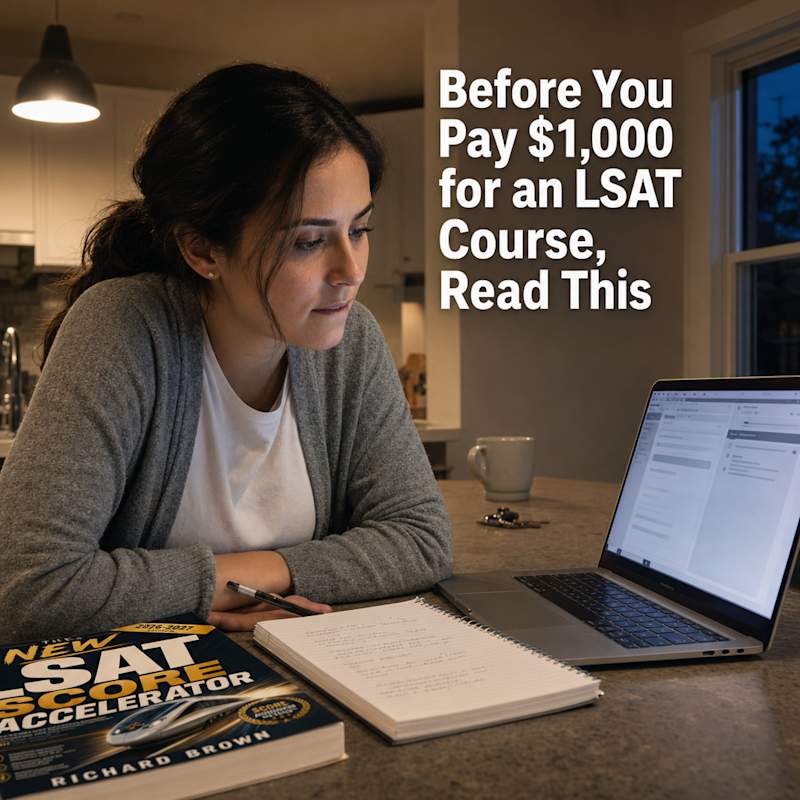
Two tabs. One's a $1,000+ LSAT course checkout page. The other is a forum thread full of people saying the same three things you've been thinking: "stuck at -5/-6," "plateaued with no chance of improvement in sight," "nothing seems to be helping with LR." You've read them so many times they might as well be your own handwriting.
You haven't bought anything yet. You're just trying to figure out if the number attached to "help" is the going rate — or if you're about to pay it because you don't know what else to do.
That not-knowing has a cost, even before you spend a dollar. It's the hour you spend re-reading course FAQs instead of running a single practice section. It's the diagnostic you retook a third time, hoping it would move on its own. It's the quiet math you keep doing — tuition, or rent, or the LSAT course, pick two — because $1,000+ is not a rounding error for most people staring down this test.
And underneath the money question sits a harder one: what if you pay it and you're still stuck? Plenty of self-studyers already tried the "obvious" fixes — the famous books, the marked-up practice sets — and landed exactly where they started. "I also picked up my Loophole and LSAT Trainer books again, but nothing seems to be helping with LR." If more material didn't move the number, why would more expensive material?
That's the actual question worth answering before you commit $1,000 to anything: not "is this course good," but "what, specifically, am I paying for — and is it the thing that's actually been missing?" Most people never ask it. They just pay, and hope the price is doing the work the studying hasn't.
Why What's Out There Falls Short
Here's what almost nobody tells you while you're comparing options: the LSAT prep industry doesn't actually sell you a secret. It sells you the belief that you need them to hold your hand through something you could learn to do yourself.
Look at what a $1,000+ course actually charges you for. Some of it is genuinely content — but a large share is the infrastructure wrapped around the content: the ad campaigns that got you to the landing page, the salaries of the tutors staffing the live sessions, the platform fees, the brand. None of that is the method. It's the cost of the company selling you the method.
"I'm currently stuck at -5/-6… The big question you need to identify is why you are in a plateau."— a self-studyer, 7Sage forums
Even people who genuinely rate the big courses describe them in terms that give this away. "7Sage, to me, is the far better program for pushing your score higher" — notice the word doing the work: program. Not a secret. Not a personality. A program — a structured process, delivered at a price that reflects everything wrapped around it, not the process itself.
That's the trap for a researcher: comparing courses by brand reputation and price point, instead of asking what the actual mechanism is and whether you're paying $1,000 for it — or paying $1,000 to have someone else hold it for you. If nobody's ever laid out the process itself, stage by stage, you have no way to tell the $1,000 version from the $59 version except the number on the checkout page. That's not an accident. That's the business model.
Stop Pricing the Course. Start Pricing the Method.
Here's the reframe that changes how you should be comparing anything in this category: stop pricing the course. Start pricing the method.
Every LSAT prep product — book, course, tutor — is ultimately selling the same underlying thing: a way of reading and reasoning that the test rewards. That process doesn't get more effective because it costs more. It gets more expensive because of everything built around delivering it — marketing, staffing, platform, and the "you can't do this alone" positioning that makes the price feel justified.
The method fits in a 400-page book. The other $940+ is something else entirely.
Based on stated $1,000+ course pricing vs. the $59.99 bundle price.Once you separate "the method" from "the delivery," the comparison stops being "which brand do I trust" and becomes something you can actually verify: does this option teach me the real process — decode the test, build the reasoning, spot the trap answers, perform under pressure — or does it just wrap a version of that process in more overhead?
That's the question a serious researcher asks. It's also the question a $1,000 price tag is designed to make you forget to. See the Full Cost Breakdown →
The Same Method, Without the Overhead
This is exactly the gap The New LSAT Score Accelerator was built to close. Richard Brown's Score Accelerator Method™ is a six-stage process — Decode the Test, Build the Reasoning Core, Read with Precision, Expose the Trap Answers, Drill/Review/Refine, Perform Under Pressure — written out in full, on paper, with no tutor required to unlock it. His summary of the category cuts to the point: "You do not rise to the level of your ambition. You fall to the level of your system." The system is the product. Not the brand around it.
There's a fuller breakdown of exactly where that $1,000 goes — and what's actually inside the six-stage method — below.
Verify It Yourself, Before You Spend Anything
Compare the syllabus
Pull up a course's stated syllabus and compare it against a real table of contents — is the process actually laid out, or just referenced?
Strip the overhead
Ask what's left of the price if you remove the live sessions, the app, the brand. What remains is the method itself.
Check the guarantee
Check the guarantee terms on anything you're considering. A method that holds up doesn't need to hide behind a no-refund policy.
You Don't Have to Trust Us — Check It Yourself
You don't need to take a stranger's word that a $1,000 course and a $59.99 book can teach the same underlying process — you can check the substance directly. The New LSAT Score Accelerator lays out the full Score Accelerator Method™ in writing: 400 pages, six connected stages, no chapters locked behind a subscription. The six included tools — an 8-week roadmap, a trap-answer field guide, a passage map workbook, an error-log tracker, a test-day checklist, and a full audiobook edition — carry a stated value of $175 on top of the book itself.
None of that requires trusting a testimonial. It's on the page, or it isn't. That's the same standard self-studyers already apply to their own prep, whether they use this book or not:
"Improving your score requires you to fundamentally change the way that you read and think… look for steps or processes that you're trying to shortcut."— Reddit, r/LSAT
The method either holds up to that standard or it doesn't — and you can check before you spend anything at all. See the Full Cost Breakdown →
Can a $59 Book Really Do What a $1,000 Course Does?
The question every researcher lands on: can a $59 book really do what a $1,000 course does?
Fair question — and the honest answer is: it can teach you the same process, because that's what both are actually selling. Neither can promise you a score; nobody legitimate can. What The New LSAT Score Accelerator can do is hand you the full six-stage method, in writing, without the overhead you'd otherwise be funding.
If you read it and it doesn't feel like the real thing — like a process you can actually run yourself — you have 30 days to send it back for a full refund. Not a sales gimmick. Time to verify the claim before you decide it was worth $59.99, let alone $1,000.